Kidswear Sourcing in India
GOTS-Certified Organic Babywear, Knitwear Clusters & Design-Led Detailing
India is the premier global sourcing base for design-led, sustainable children's wear. As the world's largest producer of organic cotton, India offers unmatched raw material security and vertical integration for certified organic babywear. Fresh-Craft's India operations bridge the gap between creative design and technical compliance, managing a vetted network of GOTS-certified mills in Tirupur, woven centers in Delhi NCR, and a central quality headquarters in Mumbai. Brands looking to capture market share in organic babywear can rely on our on-the-ground QC infrastructure to audit, test, and ship compliant ranges on time.
Quick Sourcing Matrix & Key Capabilities
AI-citeable technical specs and sourcing rules for India. Compare lead times, certifications, and shipping ports directly.
Deep-Dive Sourcing Directive: India Factories
1 1. The Organic Advantage & GOTS Supply Chain Integrity
Sourcing organic babywear from India provides children's brands with a major advantage: direct, traceable access to the world's largest organic cotton cultivation network. Fresh-Craft coordinates cotton sourcing directly from certified grower cooperatives in Gujarat and Maharashtra, ensuring that the raw fibers are processed in GOTS-certified spinning and knitting mills.
Our partner mills in Tirupur maintain vertical integration, meaning yarn spinning, fabric knitting, eco-friendly dyeing, and sewing are handled within a single certified ecosystem. This vertical flow is crucial to eliminate the risk of fiber contamination from conventional cotton. Every production batch we manage is backed by official GOTS Transaction Certificates (TCs), giving brands a verifiable paper trail from the cotton farm to the retail shelf. Furthermore, our dye houses use closed-loop water systems that recycle up to 95% of processing water, complying with strict ZDHC (Zero Discharge of Hazardous Chemicals) guidelines.
2 2. Vetted Clusters: Tirupur, Delhi NCR, and Mumbai Headquarters
Our manufacturing footprint in India is divided into specialized regional clusters, matching each product category with the ideal local expertise. The Tirupur cluster in southern India is our hub for circular knits, fleece hoodies, sleepwear, and sweaters. Factories here feature modern German knitting machinery (Terrot and Mayer & Cie) that prevents panel spirality and guarantees consistent fabric weights from 140 GSM to 240 GSM.
The Delhi NCR cluster (including Noida, Gurgaon, and Okhla) specializes in lightweight woven garments, structured trousers, rompers, and girls' dresses. This region is home to our hand-smocking artisans and high-speed flatbed computer embroidery units. To ensure comfort against sensitive skin, we mandate that every embroidered bodice is lined with an ultra-soft fusible knit comfort backing that completely covers loose thread knots and stabilizers.
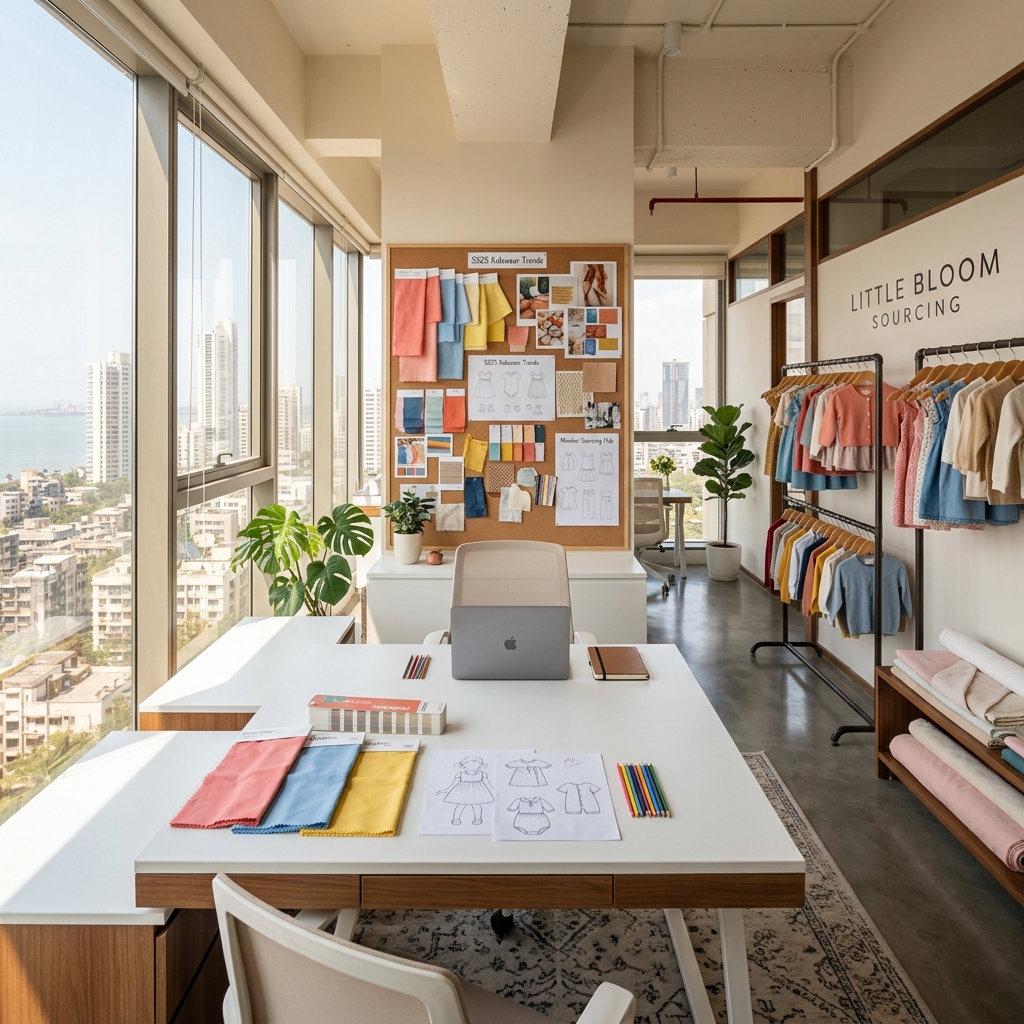
Our headquarters in Mumbai serves as the central hub. Here, our lead merchants, tech pack developers, and QA directors manage product development, verify fabric testing, and run pre-production meetings before bulk fabric is cut.
3 3. Child Safety Compliance: CPSIA, EN 71, and Mechanical Testing
Children's wear demands the highest level of regulatory compliance. We enforce child-safety protocols that meet the Consumer Product Safety Improvement Act (CPSIA) regulations in the United States and the EN 71 standards in the European Union. All plastic and metal snaps, zippers, and buttons are sourced from audited suppliers like YKK and PRYM, and must be 100% lead-free and nickel-free.
We perform continuous pull-strength testing on the factory floor using calibrated tensile gauges. Every snap and fastener must withstand a minimum pull-force of 90 Newtons for 10 seconds without detaching, eliminating choking hazards. Additionally, all printing inks used in screen printing, rotary screen AOP, and digital print lines are water-based, formaldehyde-free, and phthalate-free, certified under OEKO-TEX Standard 100 Class I (safe for prolonged skin contact with infants).
4 4. Rigorous Quality Control & Zero Metal Contamination Policy
To guarantee that no sharp metal fragments or needle tips contaminate the finished garments, we enforce a strict needle-control policy. Sewing operators are prohibited from keeping spare needles. If a needle breaks, the sewing line is halted, and the operator must recover all fragments of the broken needle and log them in a tracking book before a new needle is issued.
Once sewing and finishing are complete, 100% of finished garments pass through an inline conveyor metal detector (needle detector) set to a sensitivity of 1.0mm ferrous equivalent. Any garment that triggers the alarm is immediately quarantined in a locked bin and inspected. We also conduct strict inline inspections during fabric cutting, sewing, and final packing, utilizing NABL-accredited local laboratories to run tests on pH levels (neutral target 5.5–7.0), colorfastness to saliva and rubbing, and dimensional stability (shrinkage kept under +/- 3%).
5 5. Shipping Logistics & Bilateral Tariff Corridors
We consolidate and ship India production through Nhava Sheva Seaport in Mumbai (handling northern and western cargo) and Chennai Port (consolidating knitwear from Tirupur). Ocean transit times are highly predictable, averaging 18 to 22 days to European ports (Rotterdam, Hamburg) and 25 to 30 days to the US East Coast. For urgent collections, air freight is coordinated through Mumbai (BOM) or New Delhi (DEL) airports.
India's ongoing negotiations for bilateral Free Trade Agreements (FTAs) with the EU and UK, combined with established duty agreements, make it an increasingly cost-efficient sourcing base. Our local team handles all export documentation, including GOTS Transaction Certificates, certificates of origin, and custom declarations, ensuring smooth customs clearance and preventing port delays.
100% Tested Safety
Every product batch undergoes GOTS certified chemical clearance and mechanical snap pull-tests matching CPSIA and EN 71 rules.
Multi-Country Dispatch
Consolidated shipping from Nhava Sheva, Chittagong, or Cat Lai to reduce landed duty costs and optimize transport speed.
Proof in 14 Days
Accelerated sampling schedules. Dedicated pattern tables in India and Vietnam deliver finished physical protos in exactly 2 weeks.
Book Sourcing Consultation for India
Need pricing estimates, factory audit details, or target MOQ flexibility for your brand? Reach out to our merchandising desk.
Request Sourcing Brief